


I read every single day. At home it’s on my Kobo running KOReader (yes, I’m that open-source guy), and I love it. The problem: I don’t always have the e-reader on me. On the train, at work, waiting somewhere — I just have my phone.
I tried Kobo’s own Android app to bridge the gap and… I really didn’t like it. Promos everywhere, adding your own books is a pain, the reader itself feels clunky, and the Wi-Fi handling is annoying.
So I built my own thing: Varbook, a small self-hosted EPUB library.

You drop EPUBs into it in one click. From there:
- They’re readable on your phone through a simple but well-made PWA. Books are cached locally, so you can read offline; when you’re back online your reading position syncs to the server.
- The server exposes everything over OPDS, so any compatible app works (KOReader, Moon+ Reader, etc.).
- I also wrote a KOReader plugin that pushes/pulls your reading position to the server in a single gesture.
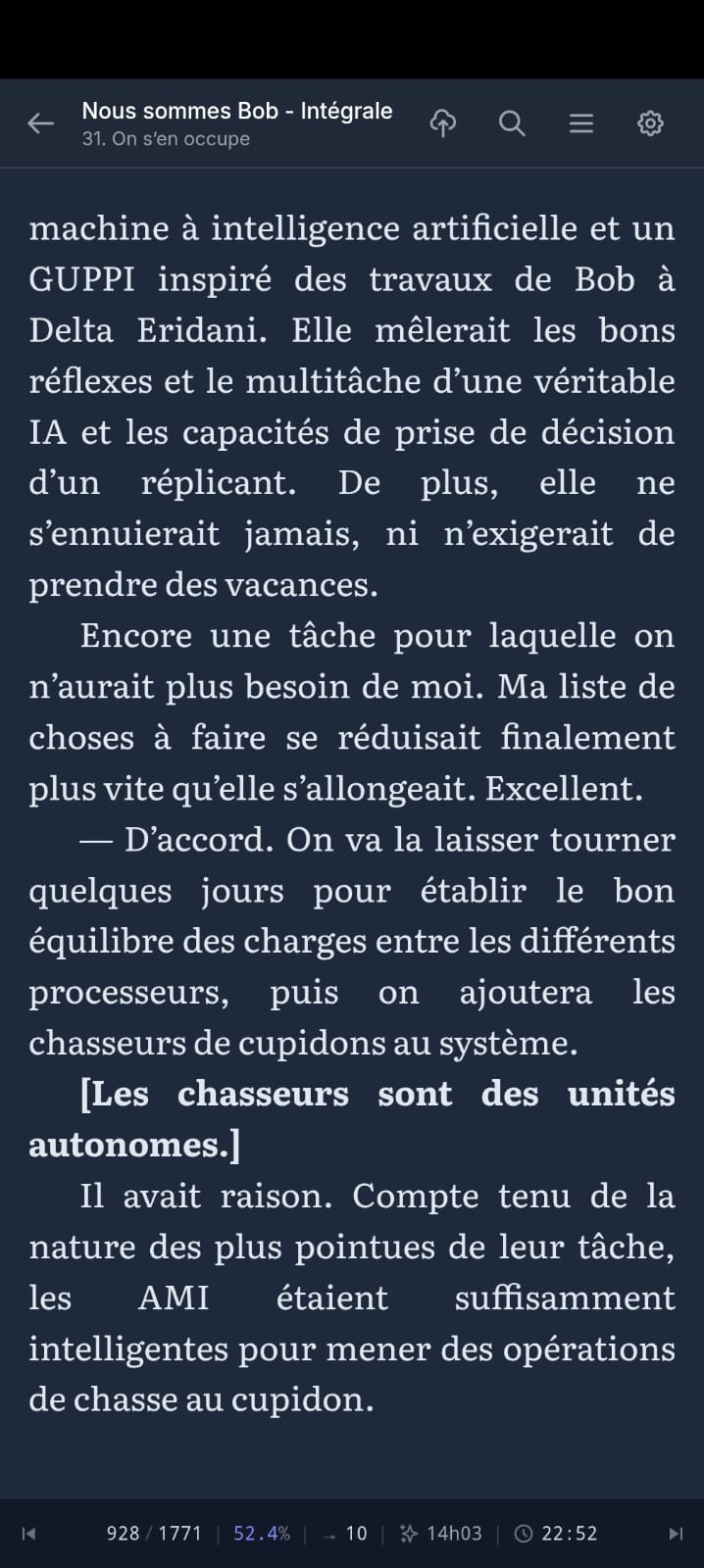
My actual daily workflow:
- Evening, at home: I wake up my Kobo in KOReader, tap the top-right corner → Wi-Fi turns on, my current book jumps to the right position, Wi-Fi turns back off to save battery.
- I read.
- Done reading: tap the top-right corner again → Wi-Fi on, my reading time + position sync to the server.
- Next day, at work: I open the PWA on my phone. It drops me exactly where I left off, and syncs my position on every page turn.
- Evening: back to the Kobo, which picks up my position from the phone.
All of this with fully open-source software, no commercial service in the loop, my books staying on my own server.
The trickiest part was cross-device position sync — every reader engine (epub.js in the browser, KOReader’s CREngine, Moon+) tracks position differently. Varbook uses a “pivot” format based on EPUB spine items (chapter index + percentage) so your position survives the jump from one device to another without throwing you 30 pages off.
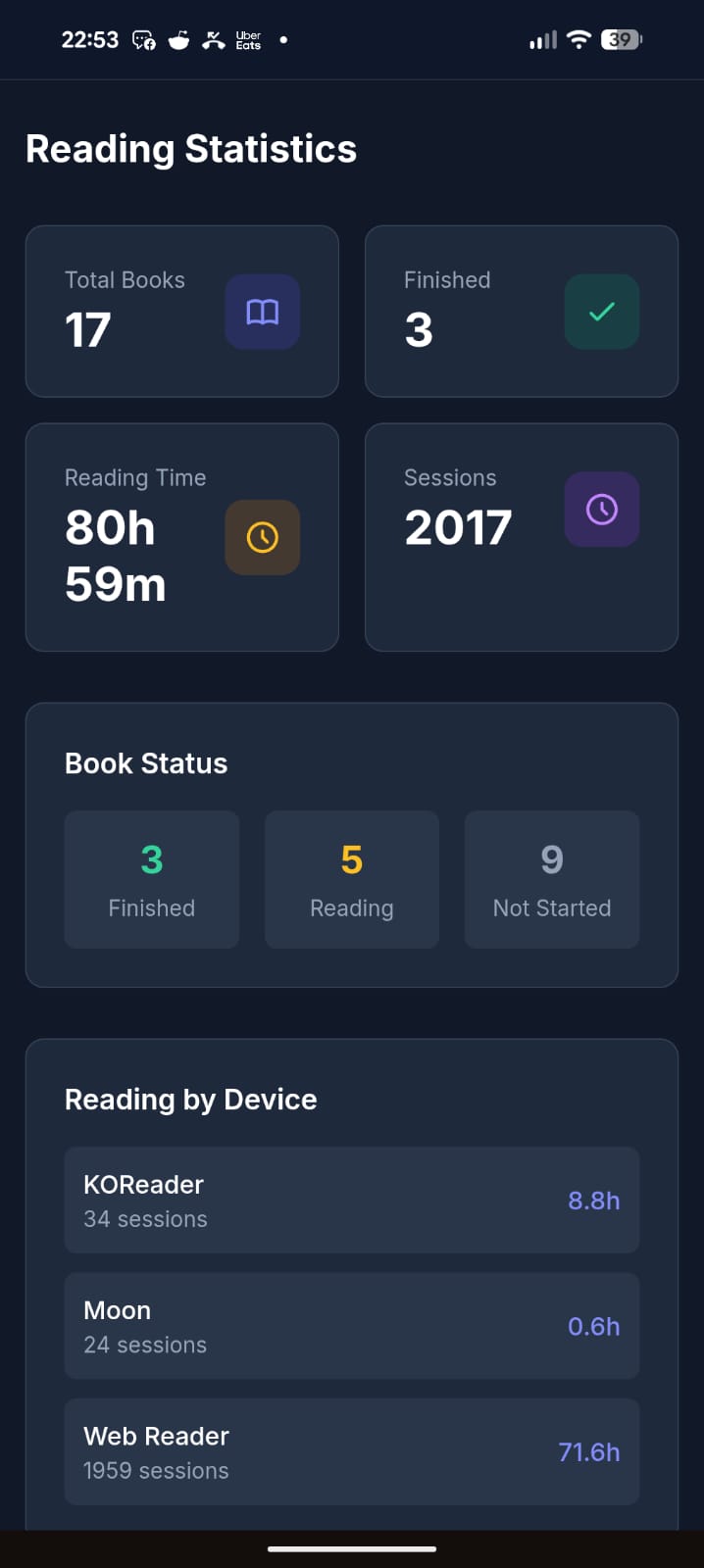
It’s open source (MIT), built with Laravel + React, and ships as a single Docker container (SQLite by default, no external DB needed). The entire UI is translated in English, French, and Spanish.
Honest disclaimer: a good chunk of this is vibe-coded. That said, I’ve been a developer for 20 years, so it’s opinionated vibe-coding — I know what I’m looking at. It’s been used daily and intensively by about 5 people for the last 3 months, and I keep improving it regularly. It’s not bug-free, but I’d call it reasonably stable. I’m being upfront so you know what you’re getting into.
There’s a free public instance if you just want to try it without installing anything: https://varbook.hophop.be/
- Full write-up on my blog: https://trucs.hophop.be/en/blog/varbook-bibliotheque-epub-self-hosted
- Code: https://github.com/ndieschburg/varbook
- KOReader plugin: https://github.com/ndieschburg/varbook.koplugin
Happy to answer questions or hear what’s missing — it scratches my own itch, but I’d love to know if it’s useful to anyone else.
Okay folks, a word on the vibe-coding thing, since I can see it stirred up a lot and clearly rubs some of you the wrong way. Let me just drop a few numbers so you have an idea of what this actually is.
I started this project in February. I work on it mostly in the evenings, after my day job. Over ~4 months I estimate I’ve put around 100 hours into it. I use it every single day, and I’ve tested and optimized it quite a bit. So no, this isn’t some thing I threw together in 2 hours with zero investment.
Yes, I built it with AI in the loop. But without it, I’d never have had the time to make something this “polished” on the side. And honestly, why would I deny myself that on a personal project? When a carpenter builds a piece of furniture, I don’t hold it against him for using a power drill instead of a hand brace.
That’s it, just a small rant. I won’t engage with the AI criticism beyond this. Back to talking about the actual software for anyone interested. Cheers.
I bet you used a keyboard, instead of a magnetic needle and a steady hand to code this too.
/s
For real though, nice work. 🎉
Most of the hard core AI haters aren’t going to be swayed one way or the other. For myself, I am concerned with security. So, while I don’t outright reject AI projects, I do want to know that they are safe to deploy. It’s 2026 and AI isn’t going away no matter the level of gnashing of teeth. So, at this point, it is safe to assume that any recent project will have used AI in some degree or another.
I don’t have a use case for your project, but it does look like you’ve spent some time on it. You had a problem, and produced a solution. Bravo! Don’t let 'em give you shit about your pony tail.
Thank you for your work! You didn’t have to share it and you did.
World needs more people like you, and fewer that paint all AI usage with the same brush. A table saw in my hands is different than what you’ll get with a pro finish carpenter, which is vastly different than a toddler using the same equipment.
People think that vibe coding is just a product directly from a prompt. Despite even best models doing completely stupid things.
Some people will hate this because they are in it for the coding experience and some agent took it from them.
Some people will hate this because of some missing features or bugs, because they wanted a product and don’t care as much about the process.
Either way, you will not satisfy everyone. Congrats on getting this out to the world!
We need more developed language for this. In my head “vibe coding” is when you write entirely in natural language prompts and don’t actually read, edit, or review the code. Everyone seems to have a different idea.
Personally, I use LLMs as a time saving tool. It writes the code I tell it to write then I carefully review all of it, every line. It saves about 50% of my time, which is very useful. Like you, I’ve been coding for 40 years in a variety of languages.
I write code for a large non profit and we quite frankly simply don’t have the manpower (or money) to do all the projects we want to do that will improve people’s lives. So it’s a reasonable compromise. AI never touches our codebase and never has access to it at all.
It’s a tool, like any other. Anyone who sets up a table saw to run by itself without careful monitoring and expertise would be fired immediately. Same thing for “vibe coders”.